Review: Modern Classics Theatre Co. of Long Island and BACCA presents The Revolutionists, by Lauren Gunderson, directed by Meredith Lynn Spencer at the BACCA Arts Center in Lindenhurst, NY., 8 March 2026. by Tony Tambasco
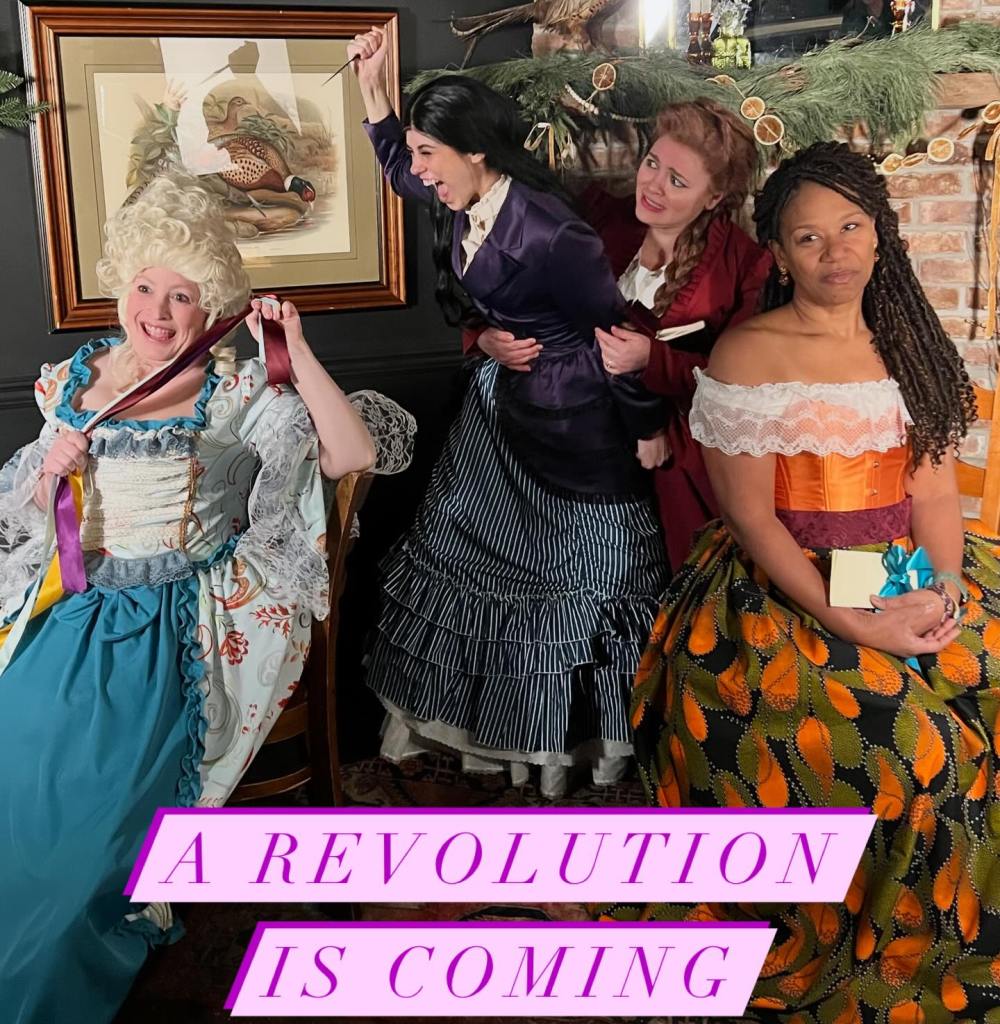
The Revolutionists by Lauren Gunderson is a lively, sharply written play that depends on specificity, quick thinking, and precise comic timing. When those elements are present, the play’s blend of historical satire and contemporary wit is an exhilarating dramatization of the need for connection as well as sacrifice in any revolution. Unfortunately, Modern Classics Theatre Co. / BACCA’s production inconsistently achieved that level of clarity or energy, resulting in a performance that felt unfocused and often dramatically inert.
The plot of The Revolutionists is loosely woven. Olympe de Gouges (played here by Jes Almeida), whom Gunderson describes as “a badass activist playwright and feminist,” has been sentenced to death for crimes against the revolution, and as she awaits her date with “Madame Guillotine,” she imagines her encounters with the Caribbean revolutionary Marianne Angelle (Karen Griffith Gordon); Charlotte Corday (Rosie Collette), the assassin of Jean-Paul Marat; and Marie Antoinette (Julie Lorson), the former queen of France whose sympathetic portrayal in one of Olympe’s plays was the reason for her execution. Olympe’s own revolutionary motives are questioned, especially by Marianne (the only one of the four characters who is not directly inspired by a historical person), and Olympe comes to terms with her own lack of revolutionary spirit. While Charlotte and Marie Antoinette are willing to stand for their beliefs in the face of their own deaths, Olympe struggles to embrace her fate, and ultimately takes comfort in both the imaginary sisterhood of the condemned, and the hope that her words will create community in future generations.
This sort of character-driven writing asks that actors be highly specific about the dramatic intention behind every word, and I found that level of specificity lacking from both Almeida and Gordon, who collapsed many of their conversations into washes of a single feeling. This lack of specificity and clarity results in these two characters rarely listening to one another (or any of the others), and that diminishes their potential for growth, and in their passionate disagreements, all we see are two people yelling at each other without having a stake in their argument. Much of the comedy early in the play was lost, as Almeida and Gordon were unable to land the comic beats effectively. While their work lends itself well to the long speeches their characters have, Almeida and Gordon’s inability to build authentic relationships on stage works against Gunderson’s attempt to redefine the revolution as about “liberté, égalité… sororité.”
Collette and Lorson, however, are both consistently more specific in their clarity of meaning and intent, and all of the characters feel more authentically bonded to one another when the action is driven by Charlotte or Marie. Collette imbues Charlotte with the passion for her cause necessary for someone who is all but certain they’ll be killed for it, while also making her vulnerable enough to wonder if it really was worthwhile as she approaches the scaffold. Lorson similarly gives Marie Antoinette the aloofness of someone who is used to being able to dictate her own reality, and also the vulnerability of a woman mourning her husband and fearful for the fates of her children. When comforting Marianne, Marie tells her “it will never be truly all right after losing him, but I’m going to say that it will because it’s really nice to hear it sometimes,” and Lorson gives the line such gravity that it answers both Marianne’s objections to the theatre as a revolutionary medium, and Olympe’s fears. Both Collette and Lorson were able to share who Charlotte and Marie were “without the riot,” as one of Gunderson’s lyrics suggests. Lorson in particular deserves praise here for consistently landing Marie’s comic beats, and was responsible for much of the laughs the performance actually received.
The lack of specificity was similarly a problem in director Meredith Lynn Spencer’s staging of the play. While the stage compositions that we are offered tend to serve the story well, they also create awkward traffic jams in certain moments, making the characters inaccessible to the audience. Most of the French names were Anglicized, which clashes with the setting of the play, but is also not internally consistent: while Olympe’s last name is given its proper French pronunciation, her first name is pronounced in a more English way. Spencer also failed to rein in some distracting stage business: Charlotte wields her knife recklessly, and slashes into her own dress, revealing a lack of awareness of the space that her costume takes up. She also regularly brandishes it at cast mates and audience alike, addressing them as ‘my friends’ in a way that seems entirely unironic. (Directors, I am begging you: do not let your actors point weapons at the audience.). Olympe often writes without dipping her feather pen, and also resorts to a feather pen, sans any inkwell, to write in her table book. There also seemed to be some confusion between the cast and the production team as to the staging convention for the beheadings. Any one of these distractions on their own wouldn’t amount to much, but taken together, and taken with some of the others I have already discussed, the production as a whole felt under-planned and under-rehearsed.
The production elements generally fared better. The set, by Thaddeus Plezia, does well to create the liminal space in which The Revolutionists is set: it evokes Olympe’s living room, while also feeling confined, suggesting the confines of her imagination. A Guillotine mounted on the highest platform looms over all of this, decorated like a bridal arch by pages of Olympe’s writing, which have delivered her both to her execution, and also to her place in history (and in Gunderson’s play). A few scattered paperbound books and a Mardi Gras chandelier were light distractions from the overall scene design. The costumes, by Janine Loesch, also serve the play well, suggesting the historical period and the class differences between the characters; the paisley print of Marianne’s dress draws focus in contrast to the other characters, but this is suitable to a character that is explicitly in the text the product of another’s imagination. The lighting, by Rian Romeo, brings this all together well, creating effective moments of isolation surrounded by darkness – no small feat in the intimate BACCA space during daylight hours – in some of the most personal of the characters’ moments.
Despite its stumbles, the play came together nicely in its final moments. This was Spencer’s clearest stage composition, and her care in staging the finale showed. The cast and all production elements combined in striking visuals and a choral sense of timing and movement that created a haunting stillness. These women, all caught up in the powers of a revolution that never made space for them, were able to accept their fates in the hope that we might be better stewards of the ideals of liberty, equality, and sisterhood that they were unable to realize in their own times. In Gunderson’s words, “the only difference between them and us is the year and the continent:” I don’t believe that’s true, but there are enough similarities that their struggles for freedom, their communities, and their personal joy and dignity still speak to us.
I’m hopeful that, with a little bit of rest, and more time to let the performances gel together, MCT/BACCA’s production of The Revolutionists will rise to the quality of the script, and the ideas that inspired it.
The Revolutionists by Lauren Gunderson. Directed by Meredith Lynn Spencer. Scenery by Thaddeus Plezia. Costumes by Janine Loesch. Lighting by Rian Romeo. Stage managed by Isabella Staples. With Jes Almeida as Olympe, Karen Griffith Gordon as Marianne, Rosie Collette as Charlotte, and Julie Lorson as Marie Antoinette. Produced by the Modern Classics Theatre Co. of Long Island (MCT) and the Babylon Citizens Council on the Arts (BACCA) at the BACCA Arts Center in Lindenhurst, NY. 8 March 2026, 2 PM. Running through 22 March 2026. Tickets and more info available at mctli.com.
 Arts & Entertainment Compass
Leave a comment